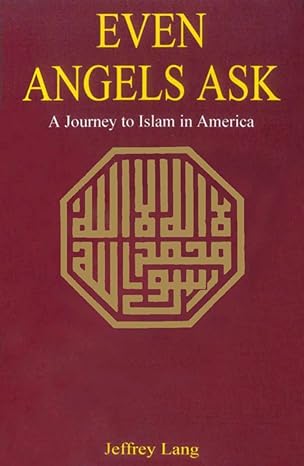
Review of Even Angels Ask by Dr. Jeffrey Lang

The Journey of a Mind Searching for Truth

Even Angels Ask by Dr. Jeffrey Lang – book cover

I must admit that this reflection comes rather late. For years I had heard of Dr. Jeffrey Lang’s Even Angels Ask, yet only recently found the opportunity to read it. Now, having done so, I can say without hesitation that it is a profoundly enriching and intellectually invigorating work.

Though its subject lies outside mathematics, Lang approaches faith with the same rigor and precision one might expect from a scholar of Algebra and Algebraic Geometry. He raises bold, penetrating questions and pursues their answers with the meticulous care of a mathematician proving a theorem — leaving no gaps, no unstated assumptions, no fragile leaps of logic. Reading him, one feels as though one is sitting in his graduate Algebra or Algebraic Geometry classes — sensing the very clarity and discipline he must have brought to his teaching.

One of the central themes Lang emphasizes is Islam’s profound emphasis on reason and rational inquiry. How can the human mind be convinced if the demands of reason and rationality are not met? If an idea cannot withstand intellectual scrutiny and retreats into irrationality, why should the human mind accept it?

Islam places reason and intellectual reflection at the heart of its call, inviting human beings to think, question, and seek the truth.

The Qur’an’s repeated criticism of those who refuse to use their intellect is an important part of this perspective.

What makes Lang’s journey particularly striking is where he began. He had been an atheist for years before his encounter with Islam. He therefore did not approach the Qur’an with an inherited Muslim identity or a ready-made religious framework. He came with questions. He read, questioned, challenged, wrestled with the Qur’an, and did not exempt his own thinking from the same scrutiny.

Lang’s journey offers a powerful example of a disciplined way of thinking in the search for truth.

There is something almost mathematical in this intellectual discipline: assumptions are examined, contradictions are confronted, reasoning is tested, and conclusions are not accepted simply because they are familiar or inherited; they are pursued through understanding. At the same time, there is a deeply philosophical dimension to his journey:

What do I know? Why do I believe it? What assumptions am I bringing with me? And am I willing to follow an honest inquiry even when it challenges what I previously thought?

Lang does not simply tell us what he came to believe; he shows us how he thought, how he questioned, how he wrestled, and how he arrived at that conviction.

One of the most moving sections of the book is his conversation with his friend Grant. Grant asks Lang a simple but profound question:

“Then why did you become a Muslim?”

Lang’s answer is remarkably clear:

“Because of the Qur’an!”

He then explains how he had read the Qur’an:

“I read the Qur’an—fought and struggled with it—argued with it—and finally capitulated to it.”

These words reveal perhaps more clearly than anything else how Lang approached the Qur’an.

Lang chose the Qur’an as his direct teacher.

He approached it without intermediaries, bringing his questions, assumptions, and doubts directly to the text—and allowing the Qur’an not only to answer his questions, but also to challenge the way he was asking them.

Through the Qur’an, he says, he surrendered to the one God whom he came to know and trust.

This conversation also reveals an important distinction in Lang’s approach. He does not determine the truth of Islam through the virtues or shortcomings of Muslims. Human beings can be mistaken, they can fail, and they may not always live up to the ideals they profess. For this reason, Lang does not take the behavior of Muslims as the ultimate measure by which Islam should be understood. Instead, he goes directly to the source—the Qur’an.

Human behavior and the source of a religion are not the same thing. Human beings can fail; to understand a truth, we must first turn to the source in which that truth is claimed to be found.

This distinction remains profoundly important today. Judging a religion through the failures of some of its followers is inadequate; so is judging it merely through the virtues of others.

Do not judge the source by the people who claim to represent it. First, understand the source itself.

This is one of the aspects of Lang’s approach that I find most thought-provoking. A person sincerely searching for truth should look beyond what others say and examine the source itself. One should read, investigate, understand context, ask difficult questions, and be willing to examine one’s own assumptions.

At this point, Lang’s journey becomes a mirror for all of us. How seriously do we ourselves engage with the Qur’an? Do we know why particular verses were revealed? Do we know what question or event a verse was addressing? Do we consider the verses before and after it? Do we try to understand a passage within the broader message of the Qur’an?

How many of us know why Surah Al-Kahf (Chapter 18, “The Cave”) was revealed and what circumstances surrounded its revelation? How many know the circumstances that led to the revelation of Surah Al-Mujadila (Chapter 58, “The Pleading Woman”)?

Do we read the Qur’an merely as a sacred book we have inherited, or as a book that genuinely calls us to think, question, investigate, and understand?

Perhaps one of the most important lessons of Lang’s journey emerges precisely here:

To use our intellect in the search for truth, not to be afraid of questions, to wrestle honestly with difficult issues, and to ground conviction in understanding.

This is not merely about how one chooses a religion; it is about how a human being searches for truth.

For this reason, Even Angels Ask is a remarkably valuable book for anyone who wishes to think seriously about faith, reason, and truth. Lang’s journey does not merely offer an answer; it teaches the reader to ask better questions and to take the search for truth more seriously.

In short, Even Angels Ask is a courageous, sincere, and intellectually compelling exploration of faith. It is certainly a book that deserves to be read, reflected upon, and perhaps returned to more than once.